Most of a commercial building can be sprinkled as light or ordinary hazard with standard spray heads. Then the drawings reach the kitchen, the enclosed car park, the transformer yard, the generator room or the comms hall, and the same pendant will not do. Those rooms are special hazards: occupancies where the fuel, the ambient temperature or the consequence of water is different enough that the base-building array has to change.
This is not a licence to invent a new standard. Australian practice still sits on AS 2118.1 for sprinklers, with wet, dry, pre-action and deluge as the system types, and with listed suppression systems over cooking appliances as a separate layer. The commercial and industrial hub collects these rooms because they are where ordinary office and retail design runs out. The office and retail piece covers tenancies; this one covers the rooms that sit behind and beneath them.
Higher temperature heads near heat sources
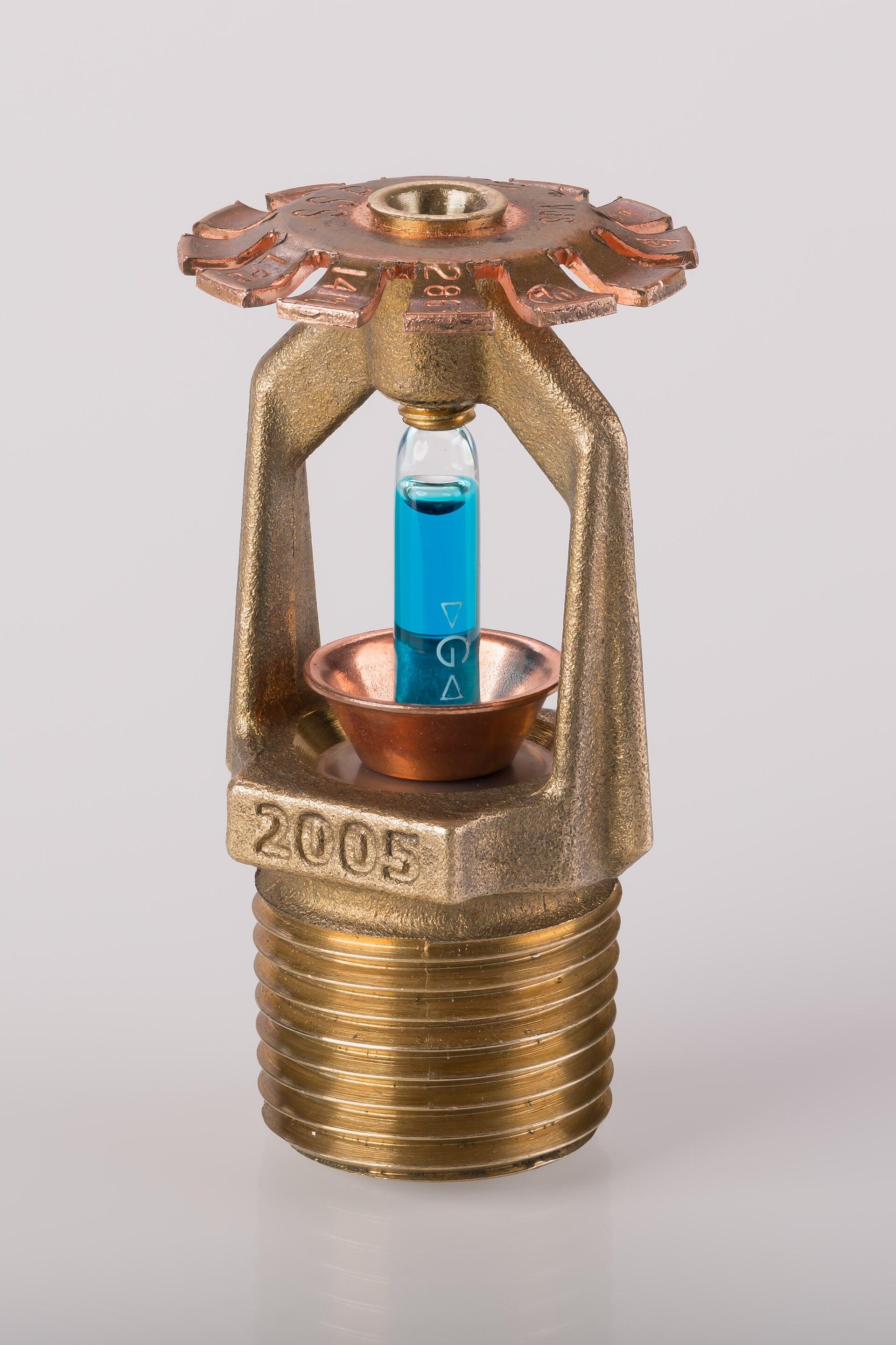
Sprinkler heads are heat-operated. The glass bulb or fusible link is made to a temperature rating, colour-coded so a competent person can see it from the floor. Ordinary-temperature heads (commonly around 68 °C, red bulb) are the right choice for most occupied rooms. They are the wrong choice over a commercial range, next to a steam line, under an uninsulated metal roof that bakes in January, or in a plant room that runs hot even when nothing is on fire.
Intermediate and high-temperature heads exist so that a head does not operate from the process, the sun or the oven, and so that it still operates when there is a fire. Extra-high ratings appear around industrial plant. The head in the photograph on this page is a high-temperature standard spray — the sort of thing you expect near heat, not over a reception desk. Matching the rating to the ambient is a design task, not a site substitution. Putting a 141 °C head in an office because the contractor had them on the truck will delay operation in a desk fire. Putting a 68 °C head in a kitchen canopy because they match the dining room will give you nuisance operation and a wet kitchen.
Skylights, feature lighting grids, plant decks and generator rooms all deserve the same look. So do concealed and recessed heads whose cover plates have their own, lower, temperature rating. A cool-looking plate under a hot soffit will drop off on a summer afternoon and leave a naked head, or worse, operate the head. Specify the assembly for the room that is actually there.
Commercial kitchens: wet chemical and sprinklers
A commercial kitchen fire is a cooking-oil fire until it is not. Wet-chemical systems on the appliances, in the plenum and up the duct are designed to saponify burning fat and to shut down the energy to the cookline. They are a listed appliance-protection system. They are not a building sprinkler system, and they do not sprinkle the servery, the dry store, the dining room or the escape corridor.
If the building is sprinkler-protected, the kitchen still gets sprinklers. The usual arrangement is wet chemical at the appliances and sprinklers in the room, with heads of an appropriate temperature rating kept out of the constant plume of the cookline. Owners who ask “do we need sprinklers if we have Ansul?” are asking whether the room and the rest of the fire compartment can go unprotected because the fryer has a bottle. Under the NCC pathway that assumed a sprinklered building, the answer is no.
What does change is coordination. The canopy, the duct, the make-up air and the wet-chemical nozzles occupy the same ceiling volume as the sprinkler heads. Fit the canopy first and drop heads wherever a gap remains, and you will violate spacing and temperature rules. Design them together. Gas shut-off, electrical shut-off and fire-indicator-panel signals from the wet-chemical system should be in the fire-services cause-and-effect, not on a sticky note in the chef’s office.
Food courts in shopping centres are a cluster of these problems: several cooklines, shared ductwork, a mall sprinkler grid, and tenancy isolations. Treat each kitchen as a special hazard inside the centre, not as another shop with a different smell.
Enclosed car parks and electric vehicle charging
Class 7a car parks split, in the NCC, into open-deck and enclosed. Open-deck parks rely on natural ventilation and often have no sprinklers. Enclosed parks, especially those under a building, are a different fire compartment: vehicles, fuel, tyres, and a ceiling that holds smoke. Where the Code or a performance solution requires sprinklers, the system is typically a wet-pipe ordinary-hazard array with standard spray heads, designed so that discharge can reach the vehicles and so that drainage can deal with the water.
Head location has to respect vehicle clearance, ramps, services and boom gates. Dry pipe is for places that actually freeze — alpine, some cold-store docks — not for a Brisbane basement because someone likes dry systems. Isolation valves should be arranged so a tenancy fitout above does not shut the park, and so a contractor working in the park does not shut the offices.
Electric vehicle charging is the emerging overlay, and it is a place this journal will stay cautious. A lithium-ion traction battery in thermal runaway is not the same fire as a petrol pool. It can burn hotter in the cell, re-ignite, and keep going after the cabin fire is knocked down. Australian research, fire-service guidance and overseas test work all suggest that water still has a cooling job — protecting neighbouring vehicles and the structure — but that a conventional sprinkler array should not be sold as a device that “extinguishes EV batteries.” Drainage, ventilation, charging-bay location, detection and brigade access are all in play. Standards and NCC provisions are moving. If your project is adding a charging hall under a tower, get current fire-engineering advice rather than copying last year’s basement layout and hoping the heads will invent a new listing.
Do not rip out a working wet system because chargers are going in. Do not pretend the chargers make no difference. Put the charging bays on the drawings the sprinkler designer sees, and record what was assumed.
Deluge, pre-action and plant rooms
Some plant is beyond a closed-head sprinkler.
Oil-filled transformers, certain oil tanks and some industrial process structures are protected with deluge or water-spray systems: open nozzles that all run together when detection — often linear heat or flame detection — trips a deluge valve. The point is to cool steel and to wash burning oil, not to wait for a bulb over a spreading pool. Deluge water demand is large. It has to be in the hydraulic calculation and in the tank and pump sizing, and the runoff has to be considered for bunding and the environment. A transformer deluge that cannot be shown to work without emptying the building’s sprinkler tank in four minutes is not a coordinated design.
Pre-action systems keep the pipe dry (or charged with air) until detection operates, and then fill the pipe so that a subsequently opened head will discharge. They are the usual choice for records rooms, archives, museum stores and many data halls, where a single mechanical failure of a wet head would be a business-ending flood. Single-interlock and double-interlock arrangements trade nuisance-fill risk against speed. They need detection that is maintained, a valve room that is not a broom cupboard, and staff who understand that a pre-action fault is a fire-system fault, not an IT inconvenience.
Data halls are not automatically unsprinklered. The hall may be pre-action or gaseous; the corridors, UPS rooms and loading docks may be wet. Insurers sometimes ask for more than the NCC Deemed-to-Satisfy. That is a documented brief, not a quiet deletion of heads.
Generator rooms, boiler rooms and chemical stores each need their own look at fuel, temperature rating and whether a closed head is enough. Some of those rooms also have gaseous or foam systems. The cause-and-effect matrix should say which system does what, in which order, and what the sprinklers are still expected to do.
Special hazards are where a competent contractor shows their occupancy experience. A crew that has only ever hung concealed pendants in shops will not automatically get a kitchen, a basement park or a transformer bay right. Name the rooms in the brief. Put the wet-chemical installer, the sprinkler designer and the fire engineer in the same meeting. Then keep the temperature-rated heads, the deluge nozzles and the pre-action valve in the maintenance program, because a special-hazard system that has not been tested is just pipe in a hot room.