Australian commercial buildings usually carry more than one water-based fire system, and the arguments start when someone treats them as duplicates. Sprinklers, hydrants and hose reels are required by different Deemed-to-Satisfy provisions of the National Construction Code, designed to different Australian Standards, and used by different people at different times in a fire. One of them can, in defined cases, earn a concession that omits another. None of them is a decorative leftover from a previous Code cycle.
This comparison is for owners, facility managers and designers who are being asked to approve a fire-services drawing that shows all three — or that quietly drops one. The NCC fire sprinkler requirements article covers when sprinklers appear. The concessions article covers what else those sprinklers can buy. Here the three systems sit side by side. The piece lives in the commercial and industrial hub because that is where hydrant boosters, hose-reel cabinets and sprinkler valve rooms share a basement.
What the NCC actually requires
The Code’s fire-fighting equipment provisions are occupancy- and geometry-driven. Hydrants are the brigade’s attack system in buildings above modest size and height. Hose reels are occupant first-attack in many buildings that are not otherwise given an automatic suppression system. Sprinklers appear when effective height, building class, compartment size or a specific use triggers them, or when a performance solution relies on them.
Those are separate questions. A building can need hydrants and not sprinklers. A tall building typically needs both. A small shop may need a hose reel and nothing else. A sprinklered shopping centre may have hydrants and boosters, and may have dropped hose reels in the sprinklered compartments. Reading a single line on a consultant’s fee proposal that says “fire services” without naming the standard is how owners buy the wrong combination.
The Code then points to the installation standards. Sprinklers go to the AS 2118 series. Hydrants go to AS 2419.1. Hose reels go to AS 2441. Combined sprinkler and hydrant systems, where one network is designed to do both jobs, go to AS 2118.6 as well as the hydrant rules that still apply to outlets, boosters and brigade use. Water supplies — street mains, tanks, pumps — have to satisfy whichever systems are actually installed; that is covered in tanks and pumps.
Fire hydrants under AS 2419
A hydrant is a valved outlet. Internally, it sits in a cabinet or on a riser landing so that firefighters can connect attack hose without running it all the way from the street. Externally, it may be a street hydrant or a private yard hydrant. AS 2419.1 sets out when those outlets are required by reference from the NCC, how they are arranged, what flow and pressure they must deliver at the most disadvantaged point, and how the brigade boosts the system.
Hydrants are sized for firefighters, not for the occupant with a garden hose. The flows are large. The pressure at the outlet has to be high enough to produce a useful stream and low enough that a branch cannot injure the operator. That pressure window is one reason high-rise buildings use zones on the hydrant riser as well as on the sprinkler riser.
Coverage is about hose lay, not about heads. Designers check that a firefighter can reach every part of the floor from a hydrant outlet with the hose lengths the standard assumes, around the actual partitions, racks and vehicles. Warehouse racking that blocks a hydrant, a roller door that hides an external outlet, or a café fitout that turns a hydrant cabinet into a drinks fridge are occupancy problems, not plumbing footnotes.
Hydrants do not start by themselves. If nobody is there to open the valve and apply a stream, the hydrant is pipe in a cabinet. That is the job sprinklers exist to do in the minutes before the appliance arrives.
Hose reels under AS 2441
A hose reel is occupant first-attack: a small-diameter hose on a drum, long enough to reach a modest fire, intended for people who work in the building and have been shown how to use it. AS 2441 governs installation — location, reach, signage, the isolating valve, and the water supply. Maintenance sits under AS 1851 with the rest of the essential safety measures.
Hose reels are not hydrants. They will not replace a brigade attack on a developed warehouse fire. They are not sprinklers. They will not operate while the occupants are still discovering the fire. Used well, they knock down a bin, a pan or a workstation before the fire reaches the first sprinkler head. Used badly, they give people a reason to stay in a room they should have left.
The NCC has, for a long time, allowed hose reels to be omitted in fire compartments that are protected by sprinklers. The logic is straightforward: the automatic system is a more reliable first-attack device than a reel that depends on someone being trained, present and willing. That concession is a current-document check, not a folk memory. Some buildings keep reels anyway because a performance solution, an insurer or a workplace procedure wants them. Some buildings lose reels on the sales floor and still need them in an unsprinklered loading dock. If a drawing deletes every reel, ask which provision or which fire-engineering report authorised it, and whether any pocket of the building is still unsprinklered.
Where reels remain, they still have to reach, and they still have to be maintained. A locked cabinet, a drum that will not pull, or a reel hidden behind seasonal stock is a defect, concession or no concession.
Boosters, FDCs and how the systems work together
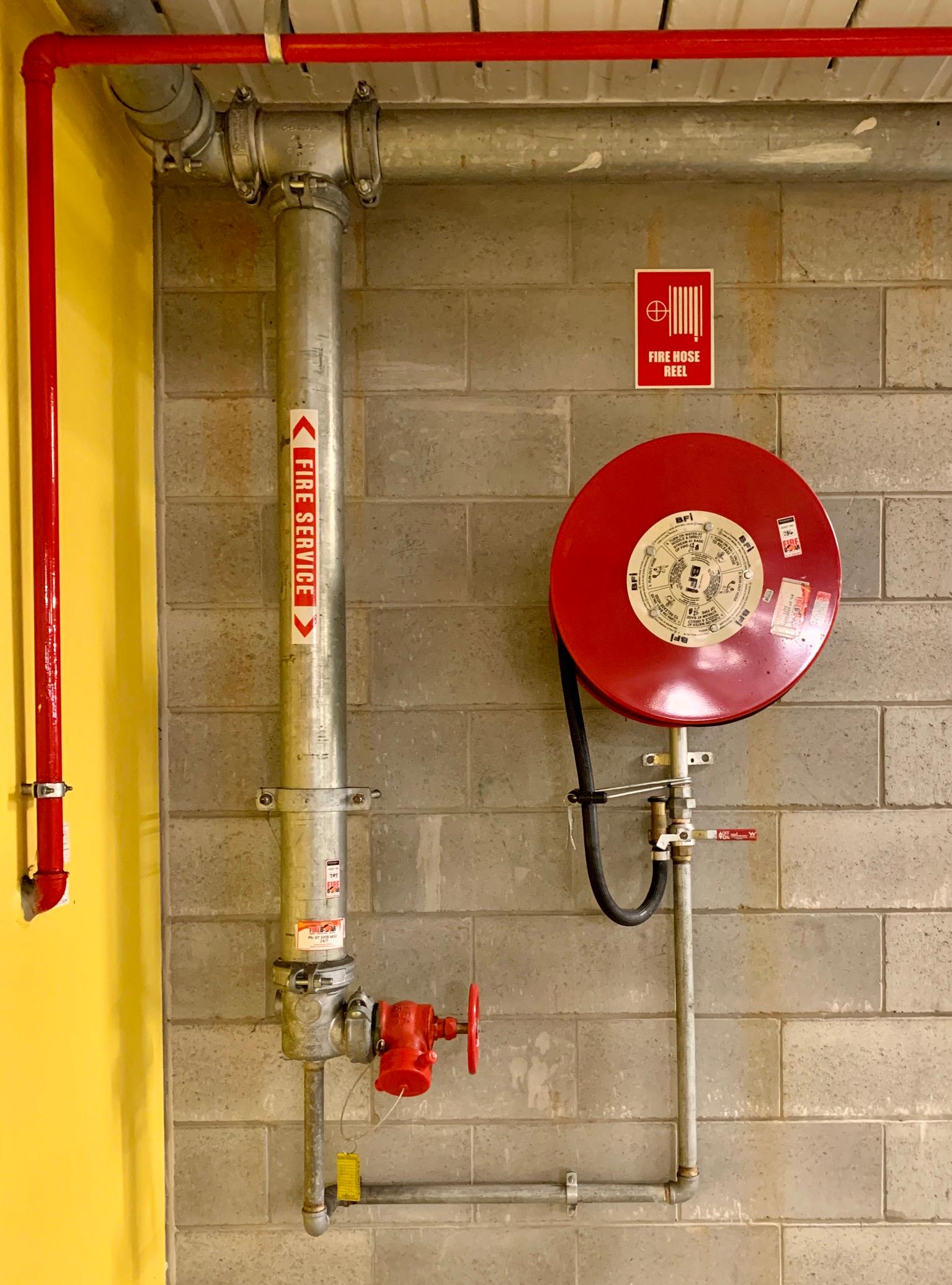
The cabinet in the photograph is the Australian street-level view of this relationship: a hose reel and a hydrant sharing a wall, ready for occupants and for the brigade. Around the corner on a larger building you will usually find the booster assembly — the inlets at which an appliance pumps into the hydrant system, and on many sites into the sprinkler system as well.
Overseas drawings call this an FDC, a fire department connection. Australian practice says fire brigade booster, booster assembly, or sometimes booster inlets. The function is the same. The brigade uses it when on-site pumps are down, when the street main is weak, or when they want to control the pressure themselves. AS 2419 sets out location, hardstand, signage, inlet type and the relationship to the pumps. A booster behind a sculpture, on a laneway that will not take an appliance, or without a block plan at the fire-control room, is a booster in name only.
On a fire, the systems are meant to stack. Sprinkler heads that have reached temperature open and control the fire in the room of origin. Occupants leave; if hose reels are present and it is still a small fire, trained staff may use them. The brigade arrives, reads the block plan, takes the booster if needed, and uses hydrants to finish the fire and to protect exposures. Water supply has to be designed for the combination the standards require — sprinklers running with hydrants, not sprinklers or hydrants on a hope that they will not coincide.
Shared tanks and pumps are common. That economy only works if the hydraulic calculation includes simultaneous demand, if the booster cannot stall the pumps, and if isolation of one system does not silently kill the other. Combined AS 2118.6 systems make that coordination explicit. Separate systems that happen to share a tank need the same honesty.
When a concession omits something — hose reels in a sprinklered compartment, a reduced fire-resistance level, a longer travel distance — write the omission down next to the system that earned it. If the sprinklers are later isolated for a fitout, or the warehouse commodity changes, the concession is no longer free. The hydrants do not automatically get better because the sprinklers were turned off.
The practical test for a commercial building is whether a brigade officer, a sprinkler technician and a centre manager can each point to their system on the same block plan and say what it does, what it needs, and what happens if it is isolated. If the answer is “the red pipe is all fire,” the NCC’s three systems have been collapsed into a colour, and that is not a design.