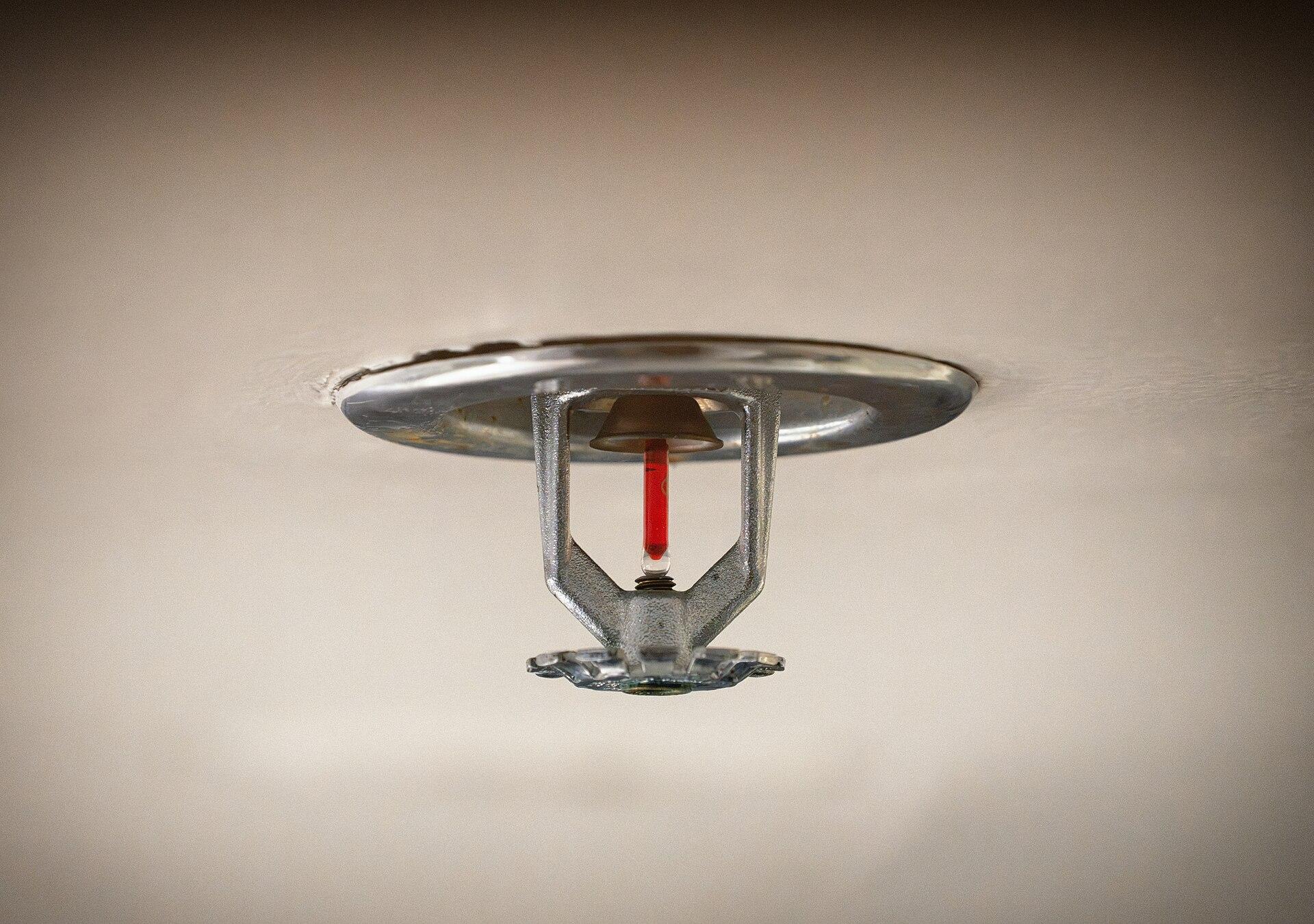
A sprinkler head is a heat-operated valve with a spray pattern, not a ceiling accessory. Pendant, recessed and concealed describe how that valve sits in the ceiling. They do not change the system type and they do not excuse a wrong temperature rating. Most specification fights on Australian fitouts are about the visible cup, when the decision that matters in a fire is the bulb, the response index, and whether anyone later painted the plate.
This is a specifier’s note for installation and design, written so an interior schedule cannot order a slower or hotter head than the hydraulic calculation assumed.
What do sprinkler bulb colours mean?
The glass bulb is a sealed ampule of liquid and a bubble. Heat expands the liquid, the bubble disappears, the bulb bursts, and the orifice opens. The colour of the liquid is a temperature band, agreed across manufacturers, so a ceiling full of mixed colours is a ceiling full of mixed decisions.
The everyday scale, in the ratings Australian contractors actually stock:
- Orange — about 57 °C. Used in some cool or sensitive spaces. Easy to nuisance-operate near a kitchen pass or a north window.
- Red — about 68 °C. The default for occupied rooms, offices, apartments, shops and most corridors.
- Yellow — about 79 °C. A step up where ambient heat is higher.
- Green — about 93 °C. Intermediate. Common in plant spaces and near warm processes.
- Blue — about 141 °C. High. Used close to heaters, ovens, or under a hot deck.
- Mauve — about 182 °C. Extra high.
- Black — the very high bands, up toward 200 °C and above, for industrial heat.
Fusible-link heads use a soldered lever instead of a bulb. They follow the same temperature idea without the colour code, so the rating is on the frame. Either type is a listed product: the rating stamped on the deflector or the frame is the one the design owns.
Choosing a hotter colour because it “won’t go off accidentally” is how you delay water over a growing fire. Choosing a colder colour under a north-west glass wall is how you get a wet desk every January. Match the rating to the ambient, then stay there. If a kitchen, a plant room or a car park needs a different band, that is a local decision, not a reason to uprate the whole floor. The myths piece covers the film version; the engineering version is that only the heads that reach their rating open, except on deluge.
Pendant, recessed, concealed, upright and sidewall
Pendant heads hang below the ceiling. You can see the frame, the bulb and the deflector. They are the cheapest, the easiest to inspect, and the least ambiguous on a maintenance round. Exposed services, warehouses, plant rooms and many back-of-house ceilings should stay pendant unless there is a genuine reason not to.
Upright heads sit on top of the pipe, deflector up, and throw a pattern that uses the ceiling as part of the distribution. They turn up on exposed pipe, in some dry-pipe ranges where water must drain back, and in spaces where a pendant would be struck. You cannot hang an upright in a pendant attitude, or the reverse, and keep the listed pattern. The frame is not symmetrical just because it looks like a metal flower.
Recessed heads sit in a cup so that most of the frame is in the ceiling void and only the bulb and deflector project. They are a compromise: tidier than a pendant, still inspectable, still a closed cup that a painter can ruin. The cup is part of the listing. Swap it for a cheaper ring and the spray pattern and the response are no longer the ones on the data sheet.
Concealed heads go one step further. A cover plate, held by a low-temperature fusible element, sits flush with the ceiling. In a fire the plate falls away, then the head behind it operates like a recessed sprinkler. The plate is not decoration. It is a listed component with its own temperature rating, usually well below the bulb, so that it drops before the head needs to open. A plate that has been painted, wallpapered, or replaced with a blank from a lighting supplier is a jammed door in front of the valve.
Sidewall heads throw a half-pattern from a wall, a bulkhead or the underside of a beam. Corridors, hotel rooms, glazed facades and some heritage ceilings use them when a centre-of-bay pendant cannot be reached. They have a back-to-back spacing and a throw that is easy to break with a downstand or a curtain box. If the architect moves a bulkhead after the drawing is issued, the sidewall may now be watering the bulkhead.
Quick response versus standard response
Response Time Index, RTI, is a laboratory number for how fast the element heats. Quick-response heads have a smaller or thinner bulb (or a faster link) and a lower RTI. Standard-response heads are slower. The difference is not marketing language. In a small room it can be the difference between opening while the fire is still a single seat and opening after the layer has grown.
Australian residential methods and many occupied-room designs assume quick response. Storage and some industrial designs still use standard response, or a specific storage listing, because the fire they sized for and the spacing they used were tested that way. You cannot “upgrade” a warehouse to quick response by swapping heads and leaving the spacing and density alone. You also cannot drop a standard-response pendant into a residential ceiling because it was on special.
Concealed and recessed assemblies have their own response conversation. The cover plate and the cup sit between the fire gases and the bulb. A listed concealed quick-response head has been tested as an assembly. An unlisted mix of plate, cup and head has not. If the specification says quick response, the product on the ceiling must be that assembly, not a standard head hiding behind a pretty plate.
Can I paint a concealed sprinkler?
No. This is the defect I write about more than any other head issue, because it is done with good intentions.
Paint on a cover plate can glue the plate to the ceiling or to its own ring. Paint on a bulb or a link changes how the element absorbs heat and can stop it bursting. Paint on a deflector changes the spray. Even a light mist from a ceiling renovation is enough. The factory finish is the listed finish. If the interior designer wants a particular white, order that colour from the manufacturer. If the ceiling is being resprayed, mask the plates or pull them and refit listed ones.
The same rule applies to recessed cups and ordinary pendants. A gold-painted upright in a heritage foyer is a photograph, not a sprinkler. So is a head caulked into plasterboard until the bulb sits in a draughtless pocket. Heads need the air in the room.
Do not hang a display, banner or linear diffuser under the deflector. Do not swap a concealed plate for a downlight cover. Do not replace a damaged head with “the closest K-factor in the van” if the hydraulic calculation named a different one.
Residential spray and ESFR in brief
Two other families get flattened into the pendant conversation.
Residential spray heads are listed for dwelling units and similar occupancies. They often appear in Class 2 and 3 work and in some FPAA residential specifications. Their pattern is intended to wet walls and the room of origin. They are the right head where the method says they are, and the wrong head in a shop converted from a flat.
ESFR — early suppression fast response — is a high-challenge storage head: a large K-factor, strong downward momentum, and a listing that depends on ceiling height, commodity, packaging and aisle layout. Used correctly, ESFR can suppress a warehouse fire from the ceiling without in-rack sprinklers. It is a system design, not a head you pick from a finishes schedule. The storage design, the water supply and the remote-area demand all change with it.
Specify heads the way you specify the valve. Name the attitude (pendant, upright, sidewall), the finish family (exposed, recessed, concealed), the temperature rating, the response, the K-factor, and the listing. Put that string on the drawing and the install specification so the ceiling contractor cannot “tidy” it. Then leave the painter a note: the plate is part of the fire system. It is not a lid.